
Columbus County Busted Mugshots
A mugshot is taken at booking. Deputies photograph and log each person brought into custody. The paper trail behind that image can run deep. Expect a name, a booking number, the date, the arresting agency, exact charge wording, bond amounts, and custody status. The Columbus County Sheriff's Office runs county detention and backs up the municipal departments. Whiteville, Tabor City, and Chadbourn police may all make arrests. Nearly all of those arrests end with booking at the Columbus County Detention Center.
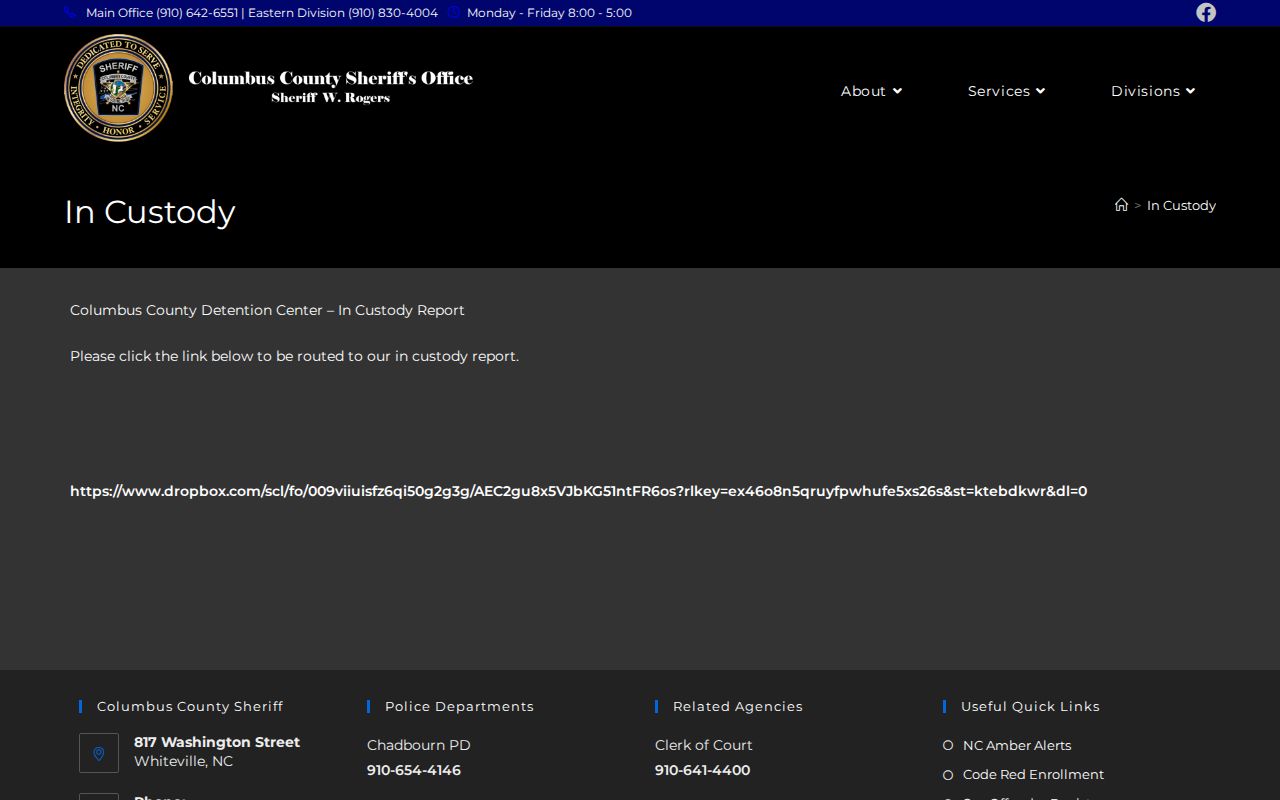
For current inmates, start with the official CCSO In Custody Report. The landing page links to dated reports in a Dropbox folder. Treat it as a snapshot of who is locked up right now. Nothing more. People come off the list after release or transfer. Fresh intakes may not appear in the newest file yet. The page says nothing about a photo policy. Anyone hunting a mugshot should confirm availability with CCSO directly or file a narrow records request for the image.
Columbus County Sheriff History
Old records live in a different world. Current rosters move fast; archives do not. The CCSO history page offers useful background on the agency, but a history write-up is not a booking source. For an old arrest sheet or a possible photo, ask CCSO whether the item survives and which retention schedule governs it. Two more leads exist. The North Carolina State Archives county guide and the Columbus County finding aid can point toward older holdings. Neither guarantees a photograph was kept or digitized.
The sheriff's retention schedule covers inmate-incarceration material. That includes detainee arrest sheets plus release and commitment papers. Those items can be destroyed three years after release or transfer, subject to restrictions. Booking photos get no separate line item anywhere in the schedule. A Dropbox file, a newspaper story, a court file, and an archival box each sit in different hands. Each follows different rules too.
What a Columbus County Booking Record Shows
Some secondary Columbus County arrest pages advertise a long list of fields. Those go far beyond what CCSO has promised on its own site. Treat such lists as a menu of what to ask for. They are not proof of what every official report contains. The smarter move is simple. Name the record you want and let the custodian say what can be released. No web page is guaranteed to show a face or a whole case history.
| Field | What it means |
|---|---|
| Name and identifiers | The person’s name, booking number, and sometimes a local identifier. Match more than a name. |
| Booking date and time | When detention intake was recorded. It is not necessarily the arrest time. |
| Arresting agency | The sheriff, municipal police department, or other agency associated with the arrest. |
| Charge as booked | The charge recorded at intake. Keep the source wording and do not turn it into a conviction. |
| Bond | A release condition or amount shown at that point. It can change after court review. |
| Custody status | Whether the person is held, released, or transferred when the record was made. |
| Photo | A booking image may exist, but CCSO’s public landing page does not confirm that it is posted. |
| Court information | A date or case reference may connect intake to later proceedings, but eCourts is not a certified copy. |
State law draws its own lines around these records. N.C.G.S. § 132-1.4 defines which basic arrest and alleged-violation information counts as public, while leaving room for other criminal-investigation material to be withheld or redacted. A second statute covers the camera itself. N.C.G.S. § 15A-502 spells out when law enforcement may take photographs and fingerprints. Neither law requires Columbus County to post any picture online.
Other Columbus County Search Pages
No verified Columbus County page turned up on Mugshots.com, Arrests.org, or Mugshots.zone. Their home pages alone prove nothing about local coverage. They say nothing about photos, opt-outs, or current records either. Should a county-specific page appear later, weigh it against CCSO and the courts before trusting the domain as a source.
Request Columbus County Booking Records
CCSO's public FAQ answers incident-report and criminal-history questions. But its pages show no dedicated booking-photo form, fixed fee, or promised turnaround. So keep the request narrow. Send it to the sheriff's records contact. Give the person's name, an approximate date, the arresting agency, and a booking number if you have one. Say exactly which item you want. One booking sheet or one image gets routed far faster than a blanket ask for every photo in a date range.
- Start with the CCSO contact page and direct the request to the records custodian.
- Describe the name, date range, agency, booking number, and record type, such as booking sheet, custody record, arrest report, release record, or booking photograph.
- Ask whether CCSO maintains the image, whether it is releasable, and whether a segregable or redacted copy is available if part of the file is withheld.
- Request a fee estimate before extensive search or reproduction. North Carolina guidance generally treats inspection separately from copy costs and permits an extraordinary service charge for extensive work.
- If access is denied, ask for the statutory basis, the custodian’s contact, and whether a narrower request can be reviewed.
CCSO records routing
Columbus County Sheriff's Office
817 Washington Street
Whiteville, NC 28472
(910) 642-6551
info@columbussheriff.com
Office hours run Monday through Friday, 8:00 a.m. to 5:00 p.m. The detention center sits at a separate address, 805 Washington Street, with mail routed through PO Box 280. Call ahead before mailing anything or making the trip.
A record being retained is not the same as a record being online. The county sheriff records schedule lets covered inmate-incarceration records be destroyed in the office three years after release or transfer. That covers detainee arrest sheets and release or commitment material. Audit requirements and litigation holds still apply. Booking photographs appear nowhere on that schedule as their own line item. Nothing promises a Dropbox report stays posted either. Ask CCSO directly how an image is indexed and how long it is kept.
Columbus County Busted Photo Requests
No photo in the CCSO report? That is not the end of the road. File a focused public-records request for the existing image. Include the full name, the approximate booking date, the arresting agency, and a booking number if known. Ask three things: whether CCSO maintains the image, whether it can be released, and whether a redacted or separable copy exists. The county publishes no fixed photo fee and no response deadline. Request a cost estimate up front, and expect no guaranteed outcome.
North Carolina Mugshot Record Law
North Carolina treats government records as public by default. Chapter 132 sets that framework, and Section 132-1.4 speaks directly to criminal matters. It opens the door to details like the time, date, place, and nature of a violation, plus basic identifying facts about the person arrested or charged, unless some other statute blocks access. Each custodian weighs the specific record. A booking photo, then, is something you request rather than something the county must post online.
No statewide statute forces counties to publish booking photos. Senate Bill 666... rather, Senate Bill 660, filed in 2021 to regulate how booking photographs spread, went nowhere and never became law. Juvenile, sealed, expunged, and investigative materials follow their own rules. Never link a juvenile to an adult secondary page, and never read a stale image as a current status.
Seeking an expunction? Start with the North Carolina Judicial Branch expunction information and its forms index. Eligibility hinges on the offense, the outcome, age, prior record, and the governing statute. § 15A-153 explains what an order does and where exceptions apply. Once granted, send official proof to CCSO and to any secondary publishers holding the record. Busted Newspaper and RecentlyBooked both describe free correction or removal processes for qualifying entries, though neither overrides a court order or wipes every copy.
For a spelling, identity, date, or status error, go to the source owner first. After the source fixes or pulls a page, a search engine's outdated-content tool can help listings catch up. Skip paid suppression services. Don't ask a publisher for a custom gallery either. The path that works is correction, a statute-specific court remedy where one exists, and steady follow-up with each publisher holding a copy.
Columbus County Busted Report Dates
Dates carry real weight here. A booking date, a report date, and a release date each answer a different question. Mixing them leads people astray. The CCSO Dropbox folder holds dated reports, but the landing page promises no daily or weekly refresh schedule. The News Reporter organizes by report period. An aggregator stamps its own last-updated time. Write each date down, and keep its custody label beside it.
Timing matters most right after an arrest. Someone can be booked before the next report appears. Someone else may be released before an older report is ever read. When the official record is what you need, ask CCSO directly.
How to Find Columbus County Busted Mugshots
The right lookup route depends on custody status. Current county detention, a released booking, a state-prison record, a federal sentence, and an immigration hold are five different animals. Each lives in a different system. Someone booked an hour ago may not show up anywhere yet. A person released last month may vanish from the current custody list while the older booking record stays requestable. Match the official source to the question you're actually asking.
- Open the official CCSO In Custody Report, follow the current dated report, and record its report date.
- If the name is absent, confirm the arresting agency and ask CCSO whether processing is complete. Do not infer release, dismissal, innocence, or guilt from absence.
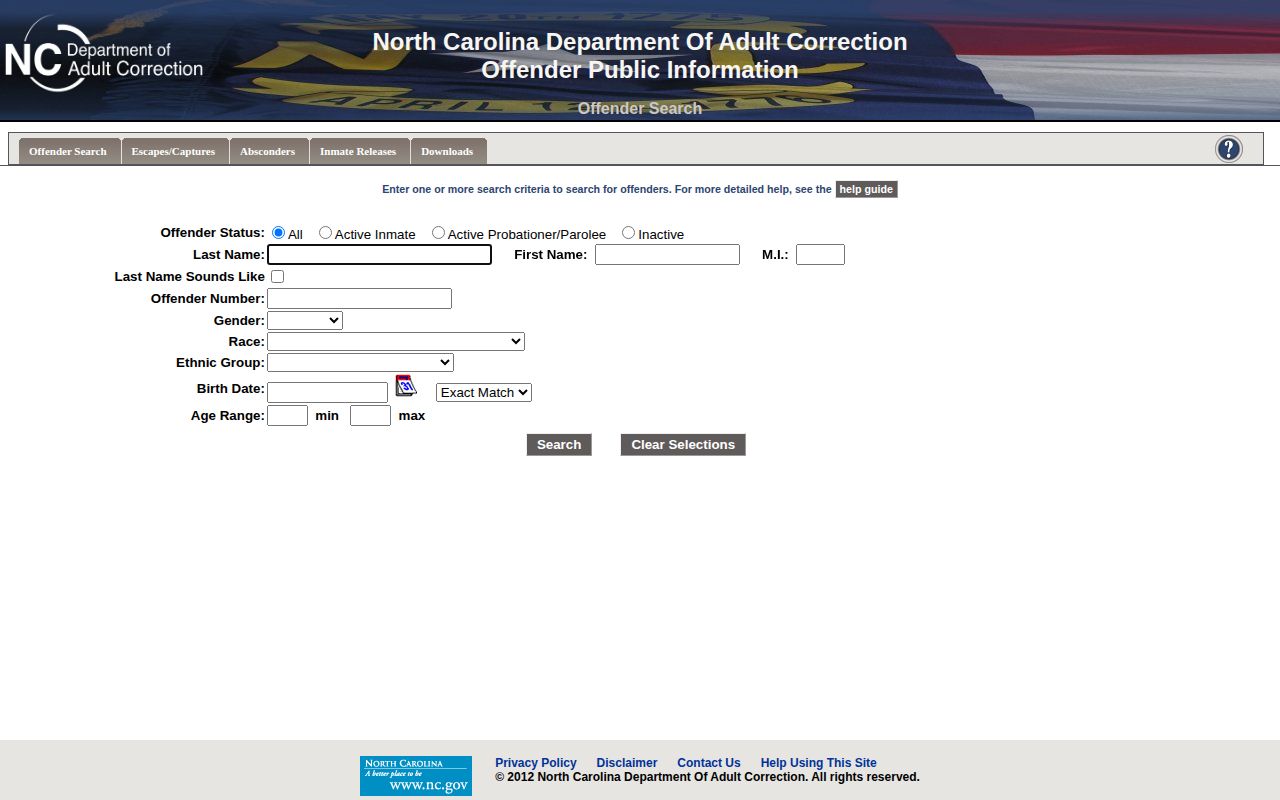
- For a state sentence, search the NCDAC offender locator. It covers prison, probation, and parole, not county jail, and its public description does not guarantee a photo.
- Use North Carolina eCourts by name, case number, or attorney for later events. Ask the Columbus County clerk for a certified or authoritative copy.
- For a released county booking or a photo not shown in the report, send the focused CCSO request described above.
The sheriff's office also offers a mobile option. The official Columbus County Sheriff app lists inmate search, Most Wanted, news, tips, emergency alerts, weather, and social sharing among its features. Treat it as a convenience channel. The store description makes no promise of immediate updates, a photo field, or a complete arrest log, and it explicitly warns against using the app in an emergency.
Busted After Release in Columbus County
Release scrambles the paper trail. A person walks out of custody and drops off the current roster, yet the booking record still sits with CCSO, in a local news issue, or in a court file. A bond order can reshuffle the roster overnight. A transfer moves the whole question to NCDAC, BOP, or another custodian entirely.
For the older county item, use the date-bounded records request path. Turn to eCourts for later events. And when a secondary page stays online, keep the source and the custody state in view.
Where Columbus County Busted Mugshots Appear
Official sources come first, always. The county's own landing page, a records request, the court path, and state or federal custody locators each answer a distinct question. Local journalism and commercial aggregators can help you pin down a date-bounded story. But they are not CCSO records. They can run late, sit incomplete, get corrected, or vanish without notice.
| Channel | Photo status | How to use it |
|---|---|---|
| CCSO In Custody Report | Not stated | Open the landing page, choose the newest dated report, and treat it as current county custody. |
| CCSO Sheriff app | Not confirmed | Use inmate search and alerts as an official convenience path, then verify with CCSO. |
| CCSO records request | Ask the custodian | Request an existing booking record or photo by name, date, agency, and number. |
| North Carolina eCourts | Not a booking-photo source | Follow the case, hearings, and disposition. Use the clerk for official copies. |
| NCDAC offender search | Photo not promised | Use only for state prison, probation, or parole records. |
| Busted Newspaper Columbus | May show secondary images | County page; unofficial and may be stale. |
| RecentlyBooked Columbus | May show secondary images | County page; unofficial, volatile, and not a CCSO service. |
| Mugshots.com, Arrests.org, Mugshots.zone | County sections not verified | Only home pages were located in this research check. Do not treat them as confirmed Columbus sources. |
The official custody landing page leads to the report workflow rather than a photo gallery, which tells you what to expect before you start clicking.
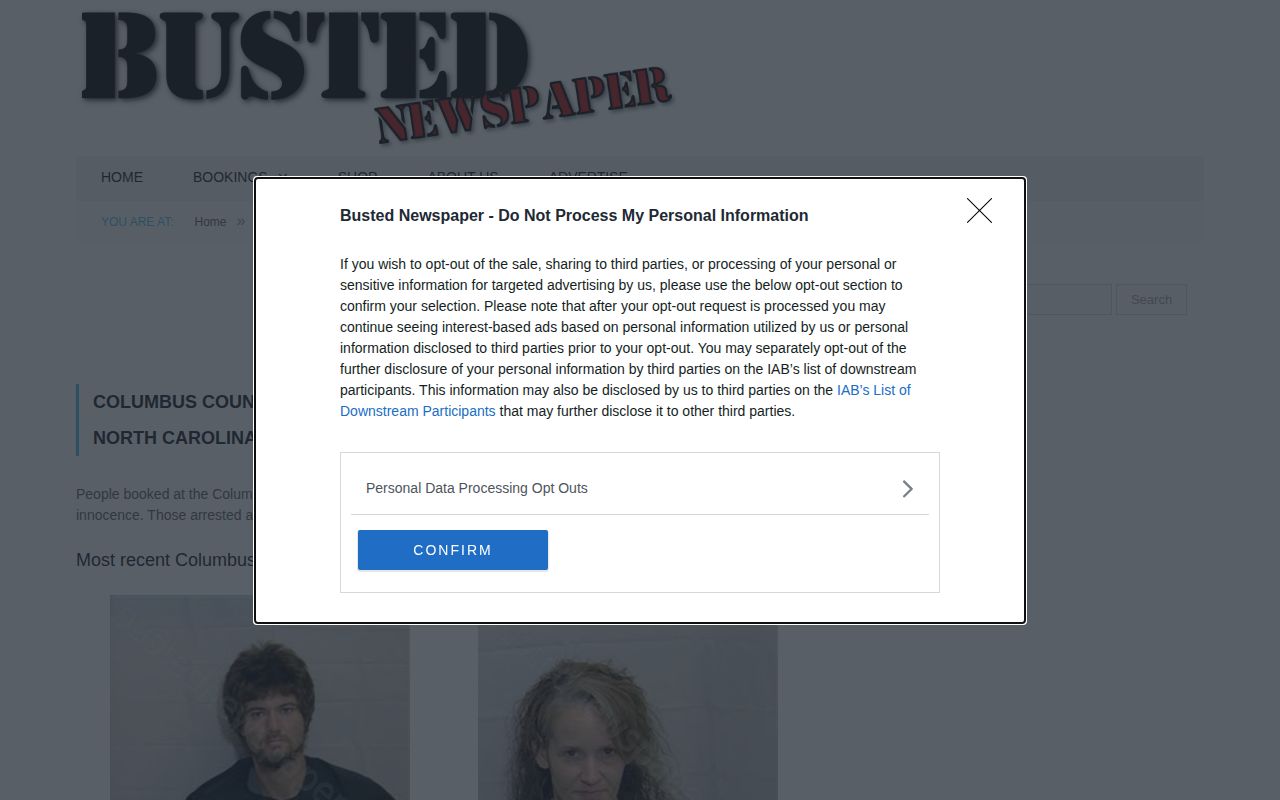
A Busted Newspaper county capture shows what a secondary interface looks like, but it is not an official roster, and no image from it should be copied or treated as a gallery item.
Columbus County Busted Court Records
The booking record is only the start of the trail. North Carolina eCourts takes it further. It shows case summaries, events, hearings, and outcomes, searchable by name, case number, or attorney. For a certified or authoritative copy, the Columbus County clerk is the route. Keep in mind that an online case display says nothing about whether a booking photo remains public.
Always compare the court event date against the CCSO report date. A dismissal, plea, judgment, or changed charge belongs to the court record. Guessing it from a roster entry or news story invites error.
Busted and Booked in the County Roster
Columbus County offers no verified native search form on its CCSO page. The official record arrives as a dated PDF workflow instead. It may be text-searchable. But the source promises no search field, no fixed cadence, no image policy, and no permanent online home. That's why the report title and date matter more than any direct file link. A Dropbox file can move or be replaced without notice.
| Search question | What the source supports |
|---|---|
| Who is in custody now? | Use the newest visible CCSO In Custody Report and note its production date. |
| Can I search by name? | Search the PDF if its text layer permits it; otherwise review pages manually. |
| Is there a photo? | CCSO’s public landing page does not state. Request the existing image if needed. |
| How often is it refreshed? | No fixed schedule was verified. Dated reports show reporting history, not a service promise. |
- Open the CCSO landing page instead of relying on an old direct Dropbox URL.
- Choose the newest visible report and read its title and date before reviewing entries.
- Search the file by full or partial name when possible, then verify spelling and agency.
- Write down the report date. It is a snapshot, not a live clearance or disposition.
- Contact CCSO or the arresting agency when a very recent name is missing.
Don't confuse the sheriff's detention page with a booking database. It has no photo section at all. What it does have is housekeeping: visitation days split by surname, two visiting windows each week, one 20-minute visit per inmate, a cap of four visitors, and a requirement for valid photo ID. Mail goes through USPS screening, and a kiosk runs around the clock for account deposits. Useful rules, yes. A public roster, no.
Busted Last Night? Check the Date Window
No verified CCSO feed publishes same-day or 24/48-hour bookings. The same holds for Whiteville, Tabor City, and Chadbourn. None run a public daily arrest bulletin. That gap matters. A fresh arrest can sit in limbo between the street, jail intake, the written report, and the first court date before anything appears in print. A records search is never an emergency tool. If someone is in danger, call 911.
For a multi-day or weekly window, The News Reporter is the best bet. Its recurring CCSO arrest reports run in the e-edition, and archived issues plus reprints show date-bounded reports with photos that vary by issue. Columbus County News Public Safety posts ongoing coverage of arrests, warrants, detention, bond, and agency stories. It stops short of a complete list, though. B&D Dollar Saver also runs date-bounded CCSO reports with fields like charge, bond, agency, status, and booked or released dates.
Compare sources carefully. Keep the county, agency, dates, report period, status, exact charge wording, and bond exactly as printed. Treat any count as a snapshot, not a permanent statistic. A newspaper issue, a third-party page, a CCSO report, and a court event each stand as a separate record.
North Carolina DAC Offender Photos
For state custody, start with the North Carolina Department of Adult Correction offender search. It covers people in state prison and those on probation or parole. Historical entries go back to 1972. County jail inmates are expressly excluded. A Columbus County booking may never reach NCDAC at all, and a later state sentence creates a wholly separate record.
The search tools take a seven-digit offender number, docket numbers up to ten digits, or a transportation number starting with T plus six digits. Match the agency's spelling and compare extra fields. A shared name alone proves nothing. The public description doesn't promise a photograph either, so it can't replace a CCSO booking-photo request.
For state-custody records, file through the NCDAC public-records page and its request form. Basic conviction, sentence, admission, and release details are handled differently from confidential offender material. Remember the route. This is the state system, not the Columbus County jail.
Booked, Released, or Sentenced?
Why do two sources disagree about the same person? Custody status is usually the answer. A current report drops someone after bond, a transfer, or release, yet CCSO may still hold the booking record while the court case grinds on. State and federal systems, meanwhile, start entirely new trails. Neither source is wrong; each just tracks a different moment in the process.
| Custody state | Best matching source | What it does not prove |
|---|---|---|
| Current county detention | CCSO In Custody Report | It does not show every recent arrest or guilt. |
| Released from county custody | CCSO records request, date-bounded reporting, court path | Leaving the roster does not prove dismissal. |
| State prison, probation, or parole | NCDAC offender search | It is not a county booking-photo feed. |
| Federal sentence | BOP locator | It has no public booking-photo gallery and does not cover every custody system. |
| Federal pretrial custody | Federal court, USMS, or contracted facility | A local jail location does not make it a county arrest record. |
| Immigration detention | ICE ODLS | It is not evidence of a Columbus County booking or photo. |
After a Columbus County Booking
A North Carolina criminal case can travel many roads after booking: initial appearance, release conditions, hearings, a plea, trial, dismissal, or another outcome. Bond is a court-ordered release condition, nothing more. An arraignment or first appearance is an early step, not the finish line. For local navigation, the Columbus County Courts page and its contact directory list the clerk at (910) 641-4400 and the magistrates at (910) 641-4519.
eCourts went statewide on October 13, 2025. Smart Search finds cases by name, case number, or attorney, with filters for criminal cases, county, status, and dates. Its screen is not the certified record, though. If a booking line and a court case seem to clash, keep both labels and compare dates side by side. The clerk issues the authoritative copy.
Columbus Sheriff App and Alerts
The official "Columbus County Sheriff" app by OCV LLC packs a lot into one download. Inmate search, Most Wanted, news, tips, emergency alerts, weather, and social sharing all live inside it. Grab it from the Google Play listing or the Apple developer listing. The description makes no promises about booking photos, instant updates, or full coverage of every booking. Also, it's no substitute for 911.
CodeRED handles emergency and community alerts, not daily bookings. The child-support-warrants page links to it. North Carolina SAVAN/VINE serves victims and offenders with notifications and safety planning, not face browsing. Social media posts vanish or get corrected without warning. Dated reports and court records hold up better.
Federal Custody Is Separate
The Federal Bureau of Prisons locator covers records back to 1982. A search returns name, register number, age, race, sex, release date, and location. Release dates can lag behind reality. A "Released" or "Not in BOP Custody" flag only describes the federal system, so another agency could still hold someone. The U.S. Marshals Service houses many pretrial prisoners through local contracts. Even so, its prisoner-photographs policy offers no general public photo source.
ICE runs a separate tool. The Online Detainee Locator finds people in current ICE custody or certain recent CBP custody. Search with an exact A-number plus country of birth, or an exact name plus country and date of birth. Nothing here shows a Columbus County ICE contract or a local immigration photo feed. For legal status questions, talk to qualified counsel or the agency itself.
Busted Mugshots by Columbus County City
The map ranks Whiteville, Tabor City, and Chadbourn as the top three incorporated places, with similar 2020 Census counts. Any of these cities could run its own arresting agency. Even so, most bookings flow through county detention. None of the city sources offered a complete daily booking roster for the public.
- Whiteville Busted Mugshots, 4,766 residents in the 2020 Census. The Whiteville Police Department has a Records Division, but no public daily arrest log was located.
- Tabor City Busted Mugshots, 3,781 residents. Tabor City Police has an official contact page and linked Facebook account, but no verified public arrest feed.
- Chadbourn Busted Mugshots, 1,574 residents. The town and police contact sources provide a routing point, not a public booking search.
A city name in a news story or a secondary record can hint at where the arrest happened, which agency made it, or how the item was tagged. It is not enough to assume a city department holds the booking record. The Census incorporated-place source backs the population ranking only. It says nothing about arrest volume.